

This is a beginners' guide that provides advanced guidelines to the sport of offroading in desert using 4x4 SUVs.
Going in your 4x4 to a Sahara safari is an easy and very safe experience if one follows rules set for risks that many before you have learnt the hard way. Although some risks are extremely rare, but better safe than sorry. The rules set here are tested and are all based on experience and will help you stay enjoying and safe (much safer than on the roads).
[toc]
To discuss info in this essay, go to SaharaSafaris Club on Facebook
The first and most important rule in our recreational 4x4ing is that solo 4x4ing is forbidden! Only a Caravan of 4x4s is allowed of two or more 4x4s with one highly experienced Leader.
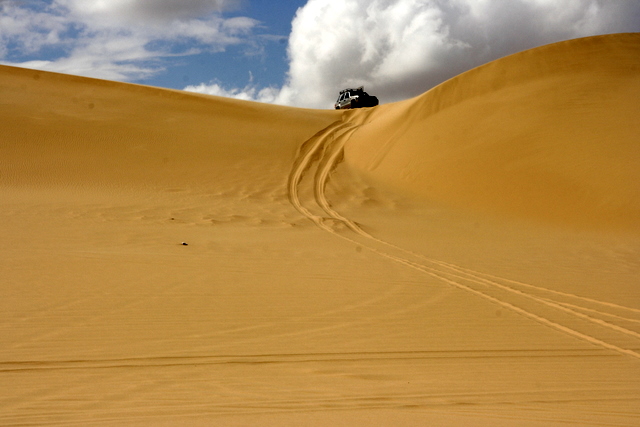
Related Essays
- What is Sand Dunes
- What is Safari Checklist
- What is Tires
- How to drive onroad in Egypt for 4x4 Caravans
- How to use Satellite Phones in Egypt
- How to prepare your car to desert 4x4ing
This article --as is the case with all www.SaharaSafaris.org articles-- is editable and is open for the Community’s continuous additions and updates. Therefore, it will remain always an unfinished project subject to Community’s new findings. If you’re not willing to contribute, you still can point out parts you think needs to be added (be positive and mention a structure and hints on how to write it!)
Important Note: Leaders instructions, if different from any part here, will prevail. It is recommended to join 4x4ing Leaders who are following some or all of the rules here.
4x4s Convoy (or sometimes Train or Caravan - Arabic: قُول / قافلة/كارافان) Order and Rules
Formation is very important for the safety and enjoyment of all the safari’s 4x4ers. The Caravan is made up of 3 main parts:
- 4x4ing Leader (Arabic: قائد): responsible for opening the way and judging if the obstacle just crossed good for the skills of all following 4x4ers. Judgment is usually final. Her/his leadership as well as macro and micro navigation skills is required to manage the group in all parts of the trip including camping arrangement, roles for persons, resources and logistics arrangements, and even accounting of costs.
- 4x4ing Collector (Arabic: القشاش): trailing at the end with high experience. Never leaving a 4x4 behind with abilities to help others cross obstacles and back to order. The Collector has to have strong experience in helping others come out of situations as fast as possible. She/he has to be in good communication with the Leader at all times. Several Collectors could be assigned in a single Caravan and if so, the additional Collectors (sometimes called Jokers) have the freedom to move anywhere in the Caravan. The Collectors have to be trusted by the Leader in experience and in good communication with her/him. Sometimes a Collector is called Camion Balai (French for sweeper truck).
- 4x4ing Caravan Sweeper (Arabic: مساعد): although with a fixed position near the Collector, Sweeper(s) could be floating anytime beside or specially behind the Caravan at anytime helping out any 4x4er who falls out in a bogged-down situation or simple issues. Sweeper(s) must be in communication with Leader or at least the Collector at all times even if they're not in sight by means of wireless. If communication breaks, Leader should stop and wait or go back to help while Collector (or Hinge if one is assigned) is in charge.
- Caravan 4x4ers
- (OPTIONALLY) 4x4ing Caravan Hinge/Deputy (Arabic: نائب ملاحة): if the Caravan is too long (above 30 4x4s) for communication, there has to be some experienced 4x4er at the middle to manage communication. She/he needs to have combined skills of Leader and Collector.
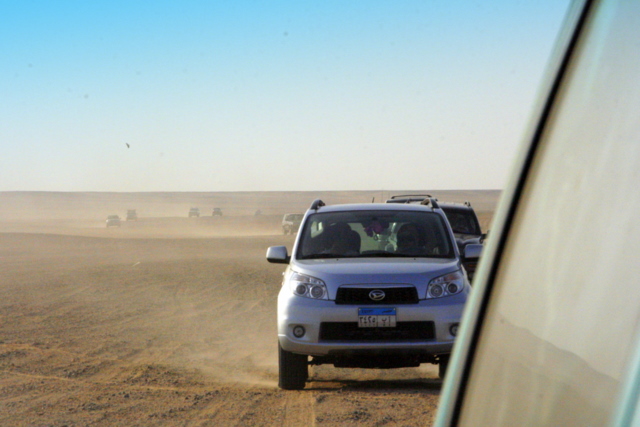
All 4x4ers (including Leader and Collector) have to honor the following in order of importance:
- Remember the 4x4 ahead and behind of you and mark your 4x4 with the number for the entire trip (you may find Leader using that number in the Radio for instructions referring to you)
- Follow Leader’s instructions on distances between yours and the 4x4 ahead of you which will be different on on-road and off-road. On-road with 100 km/hr should be in 50m approx and off-road 100m approx. In crossing tall obstacles (eg, dunes), most 4x4s have to wait while one after another is cleared to cross by Leader.
- You’ll normally leave a distance suitable for the terrain you're driving through. On roads it should be at least 50 meters. In slower offroading on rocks, it could be 20 meters. In open flat easy terrain (where one can see far), it could be 100meters. On obstacles, it's one by one waiting for each to cross until successful. Generally, you keep as much distance as possible to avoid flying dust and stones from the cars ahead and avoid their sudden stops, and as small distance as possible to not to lose sight of them.
- You stop completely if the 4x4 behind you has stopped or another 4x4 appeared in its place:
o if the 4x4 behind has slowed down, don’t consider that as sign to stop for it and keep following the one ahead of you with no widening gap,
o if the 4x4 behind has changed, you will wait for a minute or so to monitor closely situation, if the correct one doesn’t show up in order then you have to stop - You have to catch up with the 4x4 ahead of you and do that before the gap widens: if you slow down too much because of obstacles don’t fret!! Take your time to cross the obstacles, and the group will wait (see rule above). But if you’re slowing down to take a photo, you may like to notify the Leader so that everybody has a chance to do so without waiting for your every stop!
- During night, headlights’ flipping shouldn’t be taken as sign (4x4s bumpy trail gives this impression all the time). If a 4x4 driver wishes to give a sign that she/he stopped, they should turn off the lights completely, then turn on and off in clear periodic succession.
Sand-specific 4x4ing Techniques
Safe Parking
[Photo of a Safe Parking over sand with other cars still moving or Safe Parking too]
Used mainly when a Caravan is needed to halt for a reason or another on a difficult terrain (usually soft sands).
The technique is manage to stop the car on a slope in a nose-down position. This helps the driver starts the motion of the 4x4 again and gaining momentum on this difficult terrain.
If the sands are very flat in the immediate neighborhood of the place of stopping you may travel a bit further on the terrain (but stayseen by others) to find a Safe Parking spot.
Safe Parking could be maintained on any solid rock surface of any slope which 4x4s find traction easily to start motion again. Still you may like to watch on marble terrains from stopping over a sharply dented edge.
On crossing slopes never stop on the middle of the slope (unless forced of course). You may do that to recover of other 4x4s only and under supervision of the Leader. If you do, always stop with your longer axis aligned with the up-down direction of the slope (looking straight down).
On a slope of any kind, never trust hand-brakes to hold the car still! They do disengage suddenly sometimes. A secure parking must be aided by shifting to first (when engine is off) in manual transmission or place the automatic shift at P. In all cases and if keeping it overnight at this position, you should secure it below all 4 wheels by supporting large rocks. In all cases never allow anything important to stay underneath it (camp, people resting, etc.) or it might hurt them on its way down if it gotten loose. Take this Warning seriously in all kinds of vehicles.
Traction and steady push on the accelarator pedal
[photo: wheels throwing sands behind them]
Traction is the grip of a tire over the ground or the lack of slippagebetween a body and the surface on which it moves. Understanding how tomaintain traction or maximize it requires plenty of skills and varies with types of engines, 4x4s and tires features.
Following Leader
[photo: tracks on the ground with close matching of followers]
When driving on the typically difficult terrain and maintaining your distance from 4x4 ahead of you, it’s usually the case that Leader crossing points won’t be seen except through her/his trails.
Leader should indicate at the orientation (or at every stage of the 4x4ing) how far to side-deviate from the tracks (Arabic: جُرَّة). In most situations sticking to the track is obligatory (usually allowing slight deviation so that to avoid spoilt sand by previous wheel tracks).
In situations with driving along sides of slopes, 4x4ers should not go ‘higher’ than the tracks of the Leading 4x4s so that not to expose themselves to extreme side sloping situations that the Leader has decided to avoid and which appear nearer to the top.
Driving along sides of Dunes
Driving on the longitudinal dune’s sides is possible when it’s not a very steep and soft slipface. Driving should be taken with care and on the sign of too much inclination, 4x4er should steer the car down the slope with no sudden jerks. It’s usually the case that by steering towards the bottom that the 4x4 regains balance and 4x4er can stop descending and starts climbing gradually up to where the other 4x4s are on the dunes side.
The Leader takes risk of opening way if following 4x4ers in caravan find the Leader bogged-down then they need to immediately find a Safe Parking spot. If the bottom of the dune is desert-pavement (gravelly) or rocky, it may be safer to descend off the slope.
Some top-loading cars with elevated CG may not be able to drive onsome degrees of inclination and Leader should take notice of 4x4ers whodescended off the slope.
No Brakes on Sand
Using your 4x4 brakes while driving on sand at speed is advised not to be a strong one: a too strong one may lead to total loss of traction.
When coming to a complete stop on sand, try to release brakes just before it reaches total stop. This will allow the tire to stand on flat sands. If the 4x4 comes to a complete stop with strong brakes, it develops a large front in front of the wheels making the restarting of 4x4 motions almost impossible without removing such fronts by shovel or hands, or even retreating which is usually very difficult if the 4x4 stops with a nose-down position.
Deflating tires
4x4s tires on sand can benefit from additional traction by deflating the tires from the typical on-roads 30 PSI. Sometimes and in some situations, down to 8 PSI is useful. But in average, 20 seems to be good for most situations. Please note that on sharp-edged rocks, it's better to have it inflated to above 30 PSI (40 PSI is not unusual) which protects the tires from puncturing. For on-road safety, tires have to be inflated back to 30 PSI before getting on road on the way back home. If a 4x4 had to stay deflated on-road, speed should be kept very low or suffer possible problems with car-handling.
Typical Challenges
Recovery of bogged-down situations
Logic and common sense is needed here. You will need to assess the ground around the stuck car. Look for slopes, inclinations, angles, harder sands. Unless the car is stuck in too deep (which is usually the mistake of the driver giving it more fuel while trying to recover the 4x4 out of the situation), go into the first and easiest choice.....put on the 4L gear to get the max. torque, slowly press the gas pedal. If it gets out, point your nose towards a slope or towards stronger sand. Make sure not to further dig your car by pressing too much on the gas pedal. You can also move slightly the steering right and left to gain more traction, in case required. You can always get the help of a push from your fellow conveyers.
If this didn’t work out. Get out of the car; remove the sand in front of your wheels in case you decided to move forward or behind your wheels in case you decided to move backwards. You can start off by moving the sand with your hands to the use of shovels as required. Make sure to have an adequate area of sand around your wheels removed. Also make sure to remove sands away from your differentials so that to reduce sticking friction. For cars with low ground clearance bumpers or fiber "protector-look-alikes", try to remove sands away from them so that they do not get broken or detached whilst recovery. Put the sand mats (in the direction you are heading too) + 4L with sensible gas pedal and a push will do in many cases. In more severe situations, you may need to deflate your tires.
If still this didn't work out too, this will mean that your 4x4 is really stuck!! You will need another 4x4 to pull you out either using its own engine's torque (tied to a strap of steel wire) or by a winch. In all cases, NO ONE SHOULD STAY WITHIN THE CIRCUMFERENCE OF THE WIRE/STRAP. CONVOYERS SHOULD STAY AS FAR AS POSSIBLE AWAY FROM THE AREA AND TRY TO PROTECT THEMSELVES BY "HIDING BEHIND THEIR 4X4s, so that if the wire/strap is broken, it does not fly into any of them. Both drivers should synchronize the recovery together, by giving their engines the required torque towards the slope or the harder sand area.
There are more tactical situations which would need some more common sense and knowledge of your 4x4..... being stuck at the peak of a step "selemah" dune with your 4 wheels not having any or low traction, for example. The only way here is with the help of another 4x4 or its winch. Make sure to stop your engine so that to put your gearbox in P position (if automatic) or give it the first gear (if manual), put on your parking brakes to the maximum and disengage your 4H. Also take ultimate caution when hooking or D-ringing the strap to your 4x4, since you will be underneath your vehicle doing that. When being pulled down (put on your reverse gear and have your 4x4 on 4L for more control), make sure to be very careful with the gas pedal so that not to gain a lot of momentum down the dune and could ultimately hit your rescuer.
Understanding Landforms
Driving in the desert requires a good understanding of landforms and names. For communication it’s important to know the landmarks names (such as Seif, Sand-sea, Qara, etc.) for navigation and good dealing with obstacles. By recognizing a landform the 4x4er is able to realize the rest of the landform that she/he cannot see from their approach view.
Science of landforms is known as geo-morphology (geo=earth, and morphology=shape).
Ascending/Descending Slopes
Slopes must be approached perpendicular to the axis of the slope.The risk being tipping over, by climbing this way on a steep slope, a 4x4 is placed so that its long axis is towards the direction of turnover and therefore safe. By approaching the slope in other angles,the smaller axis of the car (width) is exposed and may cause the car to overturn on its side.
In practice many 4x4s cannot ascend on the first try and may have to slightly increase the speed and have another try. If you have to retreat, descending must be done without turning: 4x4er shift rear.
What to do when you get bogged down (Arabic: غرز)
This is when the fun begins.
You are going steady on your gas pedal, your 4x4 is running happily in its natural habitat and all over a sudden your engine starts roaring as an angry lion, your car slows down, you keep on pushing down on your pedal, the lion keeps on roaring and it comes down to a full rest; this is when you know that you are stuck.
Well it is always good to know what to do when you get bogged down (Arabic: غرزت) or another vehicle is stuck in soft sands.
- when you feel that your car is slowing down try to direct your car to an area where you can get better traction if possible and gain rational speed.
- Make sure that your 4x4 gear is engaged (4x4 part time in case of Jeep)
- Gain traction by maintaining a steady press on the gas pedal, the more/faster you press the faster your car wheels spins and dig more in the sand making it harderer to get out.
- in case if you came to a full stop, DO NOT try to press harder on your gas pedal.
a-step out of your car and assess the situation of your car wheels;you may be able to get out by simply removing some sand that surrounds your stuck tires and get a pushed by others.
b- Decide if you will move forward or backward
c- In hard situations you may need to put your gear on 4 wheel low; this is where your engine provide the highest torque needed to get your car out. REMEMBER you need to maintain a slow and steady speed so as not to bury the car in the sand and make it harder.
d- if you can't get good traction after applying all the above, you might considering 3 things: 1- use sand mattes (metal sheets that have some holes designed to provide traction to your car tires) put them under the car tires in the direction you are headed to (here you need help from your passengers or other drivers to put them for you). 2- flatten your tires to get more traction. 3- get pulled by another car using a snatch strap.
Purpose of the Safari
In announcement, the Leader/Organizer must make sure that all other 4x4ers are aware of the purpose and the schedule of the Safari. For example, Photography Safaris gives additional time to stops and may need a very flexible schedule. Other purposes are camping, cross-country, exploratory (drawing maps of terrain new to 4x4ers), recovery (reaching with help/tools to a remote point with a need, etc.
4x4 Mechanics
There are many types of failures that may happen in cross-country trips. Each car model has known problems and known techniques to solve it. In emergency the rules above should help you leave the failing car behind with or without few of you to guard it (your choice) and mark the spot EXACTLY on your map/GPS and then back with mechanics or towing service capable of entering into the terrain (recovery in desert is rare service and quite expensive but available.)
Such emergencies are rare and sometimes it's enough to call your mechanic on the phone (nearest road coverage or satellite phone) to know what to fix with your ready tools. In other cases you may need to allow for an additional day or two to solve it (while sending back others who have to reach city in schedule).
Anatomy of a 4x4
This is just a quick reference on 4x4s. For more thorough review, please refer to the Community for recognized courses, experts, or references.
Any 4x4 (usually referred to as SUV or Sports Utility Vehicle), has typically the following features over and above what you find in other normal cars:
Ground clearance (Arabic: الارتفاع عن الأرض)
It’s the distance under the lowest parts of the 4x4 facing the ground and which allow the wheels to cross bumps and most natural obstacles without brushing against the car’s low parts. Most 4x4s have shields covering its most sensitive parts to protect even if brushing against the ground has occurred.

Lockable Differentials (Arabic: كرونا)
It is the large bulb in the middle of both wheel axles. In fact, differentials exist in any types of cars (on the one driven axle that is) and distribute the power differently to each wheel according to speed. Their main drawback in desert situations is their design gives power mainly to the least resistant wheel. On 4x4s they could be locked to eliminate power-loss in situations when there’s one wheel spinning freely in the air.

Approach Angle (Arabic: زاوية الاقتراب)
It is the largest angle for a slope the 4x4 is approaching and which will find both car and bumper (Arabic: اكصدام) touching at the same time when it should be only tires that hit the slopes to keep your car going. Obviously, the larger this angle the better.
It’s worth noting that a car with a speed approaching a slope may have to consider the compression of wheel's suspension which will make the approach angle even smaller at this speed. Therefore, CAUTION should be taken so that the approach angle is bigger enough than this of the slope so that not to get the bumper hit the slope at a speed causing air-bags to go off with other unsafe consequences.


Departure Angle (Arabic: زاوية الديل)
It’s the same as approach angle but from behind and is affecting how the 4x4 descends from a slope. If the car’s angle is smaller than slope, then the rear bumper of the 4x4 may hit the slope before the wheel reaches the flat part. Departure angle if bad (small) may not cause major damage of the car if the car's tail hits the ground when climbing a slope.
Breakover Angle (Arabic: زاوية البطن)
With same ground clearance of two 4x4s, the one with the shorter length (shorter between the two wheel axles) will have a larger (better) breakover angle. The larger the angle the more car can cross situations which it is prone to brush its bottom parts against the ground

In the following example, note how the Wrangler (first car below) has superior angles than those of the Hummer (second car below).


Transfer Case (Arabic: فتيس غرز)
Usually made up at least of the following:
- 2H: only the rear axle of wheels is engaged and responsible for the motion of the car. Also the gears ratio is normal allowing the car to have its own transmission ratios (time to shift) in normal speeds
- 4H: same speeds ratios but with 4 wheels engaged and responsible for motion of the car. When differentials are unlocked this is called “All-Wheel Drive” or “Full-time 4WD”. To lock the differentials (serious mode of operations for the desert situations but which should never be used on roads) use “Part-time 4WD” sign on the stick.
- 4L: changing the gears ratio so that wheels receive slower speed with very high torque (Arabic: العجل يتقل). This is a very useful tool sometimes in soft sand situations when near stuck. NOTE: In some cross-over 4x4s this function doesn’t exist (such as BMW X3?)
There are other concepts important for 4x4ing in the Sahara such as:
- C.G. (or Center of Gravity)
- 4L vs 4H
- Torque vs Speed
- Drivetrain
- Electronic Stability Control: called in most cars, ESP as well as DSC (BMW), VDC (Fiat, Nissan), etc.
Anatomy of a Dune
Please read the article of Sand Dunes found elsewhere on this website.
Driving on dunes (sometimes are called dunes bashing or "Taghreed" in Egypt) requires experienced 4x4ing Leader to open ways and make good control over a Caravan in addition to handle situations. One follows Leader's trail, instructions and agreed ground-rules for safety and best experience, but all participating 4x4ers should be able to understand communication (what's a Urf) with Leader and know how to cross obstacles
- Rippled faces and slipfaces: The face on the side of wind is called windward face which is usually compressed sand good --in most cases-- to drive on without getting bogged-down. Slipfaces are those sides on the leeward side of the wind and are uncompressed and therefore cannot trust your tires traction nor steering at it.
- Urf (Arabic: عُرف) and 7arek (Arabic: حارك): Urf is where the crest of the dune is broken (French: cassé) and is sharply pointed which poses a threat of being stuck on car's bottom side with wheels dangling with no ability to move itself. 7arek/Harek is where a trough/opening/lower-crest between the Urfs on a Seif. It is at the Harek where most 4x4ers choose to cu across a dune.
- Naghza (Arabic: نغزة) and Kobaya (Arabic: كباية) Inverted Cone. Those are to sizes of the same thing. Naghza is the small car-sized or smaller but still uncrossable, and Kobaya is as big as a building in area and is quite a depression without easy outlets at any side.
- Curved (Medawar (Arabic: مدور)) or Cassé (Ata (Arabic: قَطْع))
- Longitudinal whale-backs (mesattah (Arabic: مسطح)) Vs Longitudinal Seifs (Arabic: سيف)
Desert 4x4ing Cross-country Safari Definitions
There are plenty of types of 4x4ing. We describe here what seems to be 99% of the cases we meet:
- Only for recreational purposes and other related purposes such as recovery and evacuation trips.
- Sahara is the field in which the trips are arranged. Cairo is the de facto origin of the trips. If the origin is somewhere else it will be specifically mentioned.
- Guided by a Guide and a Leader who are usually same person but in other cases maybe two different persons in the same leading 4x4.
- 4x4s are of important Ground Clearance and ability to cross the obstacles met thereof
- There are on-road parts before and after the off-road part. While the on-road is most dangerous (most accidents happen on-road) but the off-road is the scenic and most challenging part
- Could be of any duration: from a single day to a whole week or even a month
- At least two cars. Each is occupied by at least 2 persons including driver.
Other types such as industrial, scientific, military, etc. may benefitfrom this article but will not be included here. Also, regions such asArctic, Jungles, Glacial or Mountainous (good for rock-crawling) arenot considered here.
4x4s are classified (on the high-level) as two types:
- Serious 4x4s (SUV) such as Jeep Wrangler, GM Frontera, Toyota Land Cruiser, etc. , and
- Crossover 4x4s (Crossovers) which have plenty of the features of serious 4x4s but not all and is designed mainly to fill a niche in which the owner wishes to have much of the SUV but on road or easy tracks. Examples are Nissan's X-Trail, etc.
The article here will consider things to be arranged from both Leaderas well as other 4x4ers point of view. Both should be aware of all the arrangements and all responsibilities are divided on all (including knowledge of the terrain sometimes) but roles differ.
This article is confined to the 4x4 Safaris (Arabic: سفارى) done in the Sahara (Arabic: الصحراء الكبرى الأفريقية) so please use with care inother regions. Books such as those of R. A. Bagnold may indicate that traditions of such activities maybe started almost a century ago (1920s) since Kamal elDin Hussien’s (Arabic: صاحب العظمة السلطانية الأمير كمال الدين حسين) and Bagnold’s 20th century trials which have had the first trials of any motor-vehicle to desert travelling on known trails or without.
Things to be added to the checklist of recovery tools
1- GPS
2- Walkie Talkie
3- Air deflater
A great learning experience about interacting wt ur 4x4 & dunes
The past few SS trips were awesome. I have refreshed and gained the sense of my 4x4 capabilities in various situations. Thanks to the leader.
The most challenging dune that I faced was the "selemah" dune. U really need to maintain ur momentum and sensibly step on ur gas a bit more right before the tip, so that u have enough power to make it and avoid to be hanging on the peak. Probably, this will require that ur 2 front wheels leave the ground and u will have ur vechile slamming down.
My partner is a Cherokee XJ 6Cyl Manual wt first stage tuned engine... low resistance ignition cables, high performance plugs wt capacitors, full air induction system, electric super charger.....great throttling. I have a front bull-bar, which decreased my approach angle. I had to modify it to attain a higher angle, but still less than bumper w/o bull-bar. My original tires were 225/75/15. I replaced them wt 235/70/15. This gave me 10mm more of traction and some more acceleration but reduced my breakover angle wt 8.5mm. I am thinking of further modifying the wheels by bigger ones, as well as the suspension in order to increase the breakover angle, however I dont want to compromise the on-road acceleration neither the car's stability.![]()
Deflating tires
lowering tyre pressures are NEVER about ' tyre bagging',
going low in pressure is intended to get the tyre footprint to grow LONGER not wider, wider means
harder to push thru the sand and is not something you want! Going from
30psi in our 33's tyre to 15psi makes the footprint grow 65mm in length
for only 5mm increase in width